Human learning analysis
Supervised models to predict how many VR practice trials a person needs to learn a task, from first-trial behavioural metrics collected in a spreadsheet (May–Jun 2024, ENIB).
Academic project developed with a French classmate (ENIB).
- Python
- Pandas
- NumPy
- Scikit-learn
- Seaborn
- Matplotlib
- Jupyter
Problem
Given anonymised logs from a Virtual Reality learning task, predict how many practice trials each participant would need before solving the problem. The VR data had already been collected; the work was to prepare features and build models that generalise to held-out participants.
Data preparation
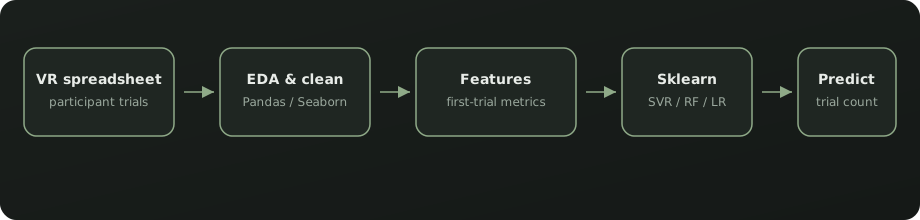
Loaded participant results from Excel with Pandas, sorted trials, and built a first-trial feature set (manipulation time, inactivity, instruction consultation, error counts, etc.) targeting total trials to success. Ran EDA with histograms, correlations, scatter matrices, and outlier checks, then applied log1p transforms and a train/test split.
Modeling & evaluation
Compared Dummy, Linear Regression, Decision Tree, SVR (with GridSearch), and Random Forest regressors in Scikit-learn. Evaluated with cross-validated MSE, true-vs-predicted scatter plots, and Seaborn confusion heatmaps after rounding predictions to integer trial counts. Linear Regression was the strongest among the early baselines; overall predictive precision remained limited on this dataset, which shaped how we reported results.